
Leadwork across Surrey
Roof leadwork in Bookhamand across Surrey, dressed andfitted the way it should be
All leadwork (valleys, flashings, soakers and abutments) formed and dressed correctly so water is carried out over the tiles instead of being sealed in with mastic. Guaranteed for 10 years.
10 year workmanship guarantee on leadwork and chimney work. £2m public liability, £10m employers' liability.
30+ years
Matt's experience on Surrey roofs
Guaranteed
Workmanship guarantee in writing
£2m / £10m
Public and employers' liability cover
Bookham based
Local across Surrey, not a call centre
The service
Lead is what makes the junctions work, and junctions are where roofs leak
The open field of a tiled roof rarely leaks. What leaks is every place the roof meets something else: a wall, a chimney, another roof plane, a dormer cheek, a parapet. Those junctions are sealed with lead, shaped to carry water out onto the tiles and away, and when the lead fails the roof leaks regardless of how good the tiling is.
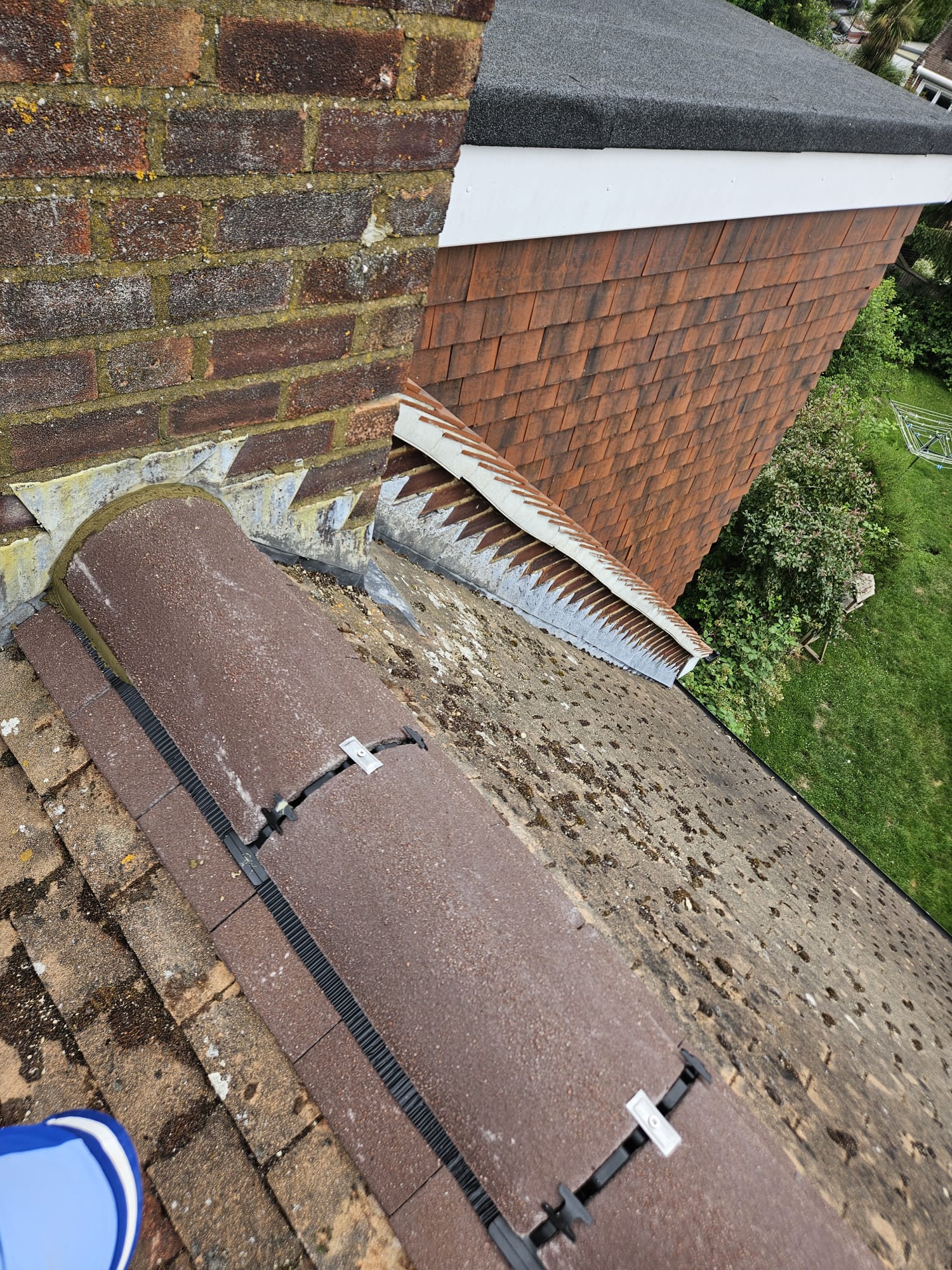
We carry out all leadwork: valley linings between two roof planes, step and cover flashings against walls, soakers between courses of tiles at an abutment, aprons and back gutters at chimneys, and dormer and parapet detailing.
Lead is a craft material. It is dressed to the shape it needs to be, lapped correctly so water always runs onto the piece below, and given room to move with temperature. Done well it lasts for decades. Done badly (or replaced with a tube of sealant) it fails within a season or two and takes the timber beneath with it.
We work on lead detailing across Bookham, Leatherhead, Fetcham, Effingham, Ashtead, Epsom, Cobham, East and West Horsley, Shalford, Woking and Guildford, on period properties, post-war housing and modern extensions where a new roof has to meet an old wall.
Leaks where the roof meets a wall
Damp appearing at the head of a wall, above an extension or in an upstairs corner is a classic abutment or flashing failure rather than a tile problem.
Houses with a valley between two roofs
Valleys carry the water from two roof planes into one channel. When the lining splits, the leak goes straight into the middle of the house.
Chimneys with damp beside them
Aprons, soakers and back gutters at a stack take concentrated water. They are the most common single leak point on a tiled roof.
Anyone who has been sold sealant
If a junction has been filled with mastic or mortar and the leak came back, the detail needs forming in lead properly. That is the work we get called in to redo.
What happens if it waits
Failed lead puts water straight into the structure, not onto the surface
Lead sits at the junctions, which means it sits exactly where the building is most vulnerable. A split valley lining drops water onto the rafters and ceiling joists in the centre of the roof. A failed abutment flashing puts it into the head of a wall and down inside the cavity or the plaster.
That is why lead failures produce internal damage faster than tile failures. There is no membrane and no roof void to catch it; the water is already past the covering by the time it reaches the lead, so a split is a direct route to timber and plaster.
Failed lead also tends to fail progressively and invisibly. Fatigue cracks from thermal movement, splits along a fold, or lead that has been dressed too tightly all open a little further each year, so the damp patch grows slowly enough for people to live with it while the timber beneath quietly rots.
Then there is the cost of the wrong repair. Mastic on a lead junction lasts a season, so the pattern becomes an annual visit and annual redecoration inside. Forming the detail correctly once is cheaper than any two of those visits, and it comes with a 10 year workmanship guarantee.
Common mistakes we get called out to fix
- Sealing a split flashing with mastic instead of replacing the lead, which hides the problem for one summer.
- Cementing a flashing into a wall joint rather than chasing it in and wedging it properly, so it pulls away as the mortar cracks.
- Dressing lead too tight and in lengths that are too long, so thermal movement fatigues and splits it.
- Laps running the wrong way, so water is directed under the piece below rather than over it.
- Reusing tired lead on a re-roof because the tiles were the visible part of the job.
- Mortar fillets used in place of proper soakers or step flashings at an abutment: a detail guaranteed to crack.
How the job runs
How leadwork is diagnosed, formed and finished
Step 1
Inspection
The junction is examined (valley, flashing, soakers, apron or back gutter) along with the tiles either side of it and, where useful, the timber and staining inside.
Step 2
Diagnosis
You are shown where the lead has failed and why: a split, a fatigue crack, incorrect laps, insufficient upstand or a previous mastic repair covering it.
Step 3
Detailed written quote
The lead, the tiling work either side, any timber and the access are itemised so the scope of the repair is clear before it starts.
Step 4
Forming and dressing
New lead is cut, dressed and lapped to the correct shape for the detail, with proper upstands, and chased and wedged into the wall where it abuts brickwork.
Step 5
Tiling and verification
Tiles either side are reset or cut to the lead, then the detail is checked to confirm water is carried out over the covering rather than behind it.
Step 6
Clear down and guarantee
Offcuts and debris are removed, gutters left clear, and leadwork guaranteed for 10 years in writing.
What you get out of it
What correctly formed leadwork gives you
Junctions that stay watertight
Correct laps, upstands and dressing mean water is directed out over the tiles every time it rains, not just when the rain is gentle.
Decades of service life
Lead is durable when it is given room to move and dressed properly. Our leadwork carries a 10 year workmanship guarantee.
No more annual sealant
One correct detail replaces the cycle of mastic repairs and the redecoration that follows each returning leak.
Timber and plaster protected
Lead failures put water directly into rafters, joists and wall heads. Fixing them properly is structural protection, not cosmetic work.
Right for period property
Traditional lead detailing suits older Surrey houses far better than modern sealants, and looks like it belongs there.
One trade for the whole junction
Lead, tiling and chimney brickwork all meet at the same point, and we cover all three, so nothing gets left for someone else.
In detail
The lead details we form, and where each one is used
Leadwork is a set of specific details, each doing a specific job. These are the ones that matter on domestic roofs.
Valleys
A valley is the internal angle where two roof planes meet, and it carries the water from both. Lead-lined valleys are common on Surrey properties, particularly period houses and anywhere with a rear addition.
Because flow is concentrated, valleys fail earlier than the open roof. Splits usually appear along the centre line or where the lead has been dressed too tightly over a hard edge.
Renewing a valley involves the tiles either side as well as the lining; they need cutting and bedding to the lead for the valley to work as designed.
Flashings, soakers and abutments
Where a roof meets a wall (an extension against the house, a lean-to, a parapet) the junction is sealed with a cover or step flashing chased into the brickwork, or with soakers interleaved between the courses of tiles.
Upstand height decides whether the detail works in driving rain. Too low, and water simply steps over the top of it, which is one of the most common faults we find.
Mortar fillets in these positions are a false economy. They crack as the building moves, and every crack is a direct route into the wall head.
Chimney aprons and back gutters
A stack passing through a roof needs a front apron, side step flashings or soakers, and a back gutter behind it. Each has to lap into the next so water is handed on and out.
The back gutter is the highest-risk lead detail on a house because it collects water coming down from above the stack. Failures there produce damp beside the chimney very quickly.
Chimney leadwork and chimney brickwork are one job, and both carry a 10 year workmanship guarantee.
Dormers, bays, parapets and flat roof upstands
Dormer cheeks and their junctions with the main roof pack several details into a very small, exposed area; patience matters more than speed there.
Bay roofs and parapets need lead at the wall junction and often along a shallow gutter behind the parapet, another place where standing water finds any weakness.
Flat roofs meeting a wall need a properly formed upstand, and lead is frequently the right material for the junction. Flat roofing is one of our strongest areas, so the two are often part of the same job.
New lead versus repair, on Surrey houses
Where lead is sound but a single lap or fixing has moved, a genuine repair is possible and we will do it rather than replace what does not need replacing.
Where lead has fatigue cracks, has been dressed too tightly, or has already been mastic-repaired several times, replacing the detail is the only outcome that holds.
Local housing mixes period roofs with valleys and complex junctions and modern extensions meeting old brickwork, so lead detailing is a large part of the repair work we do across the area.
Where we work
Covering Bookham
and the towns around it
We are based at The Manse, Eastwick Road, Bookham, Surrey and work across these Surrey towns and villages.
- Leadwork in Bookham
- Leadwork in Great Bookham
- Leadwork in Leatherhead
- Leadwork in Fetcham
- Leadwork in Effingham
- Leadwork in Ashtead
- Leadwork in Epsom
- Leadwork in Cobham
- Leadwork in East Horsley
- Leadwork in West Horsley
- Leadwork in Shalford
- Leadwork in Woking
- Leadwork in Guildford
Not sure whether you are in range? Call 07877 013968 and we will tell you straight away.
Related work
Often done at the same time
See every roofing service we offer or go back to the homepage.
Questions
Straight answers
before you commit
Anything not covered here, ask Matt directly on 07877 013968.
How much does leadwork cost in Surrey?
It depends on the detail (a section of step flashing is very different from a full valley lining) plus the tiling work either side and the access needed. Matt looks at the junction and gives an itemised written quote before anything starts.
How long does leadwork take?
Many domestic lead repairs, such as a flashing or an apron, are completed in a single visit. A full valley or chimney detail takes longer, and the timescale is given before the work is booked.
Is leadwork guaranteed?
Yes: leadwork and chimney work carry a 10 year workmanship guarantee, confirmed in writing when the job is finished.
How long does lead last on a roof?
Correctly dressed lead, in appropriate lengths with room to move and correct laps, lasts decades. What shortens its life is being dressed too tight, made up in over-long pieces, or patched with mastic that traps water behind it.
Can you just seal my flashing instead?
We would rather not, and we will tell you why. Sealant on a failed lead junction lasts a season, and each return visit costs more than forming the detail correctly once.
Why is my leak next to the chimney?
Because the lead around a stack (apron, soakers or step flashings, and the back gutter) takes concentrated water from the roof above it. It is the most common leak point on a tiled roof and the most commonly patched instead of repaired.
Do you replace lead valleys?
Yes, including cutting and bedding the tiles either side so the valley works as it was designed to rather than just having a new lining laid in it.
Do you deal with urgent lead failures?
Yes. If water is coming in, call rather than use the form. Our hours are Monday to Saturday 8am to 6:30pm and Sunday 9am to 4pm, and we will tell you honestly when we can get to you.
Is lead work suitable for a period property?
It is usually the correct material for one. Traditional lead detailing suits older brickwork and tiled roofs far better than modern sealed alternatives, and it looks appropriate on the building.
Which areas do you cover?
We are based in Bookham and cover Great and Little Bookham, Leatherhead, Fetcham, Effingham, Ashtead, Epsom, Cobham, East and West Horsley, Shalford, Woking and Guildford.
Next step
Get the junction formedproperly this time
Send the form and Matt will look at the valley, flashing or chimney detail, explain what has failed, and put a detailed quote in writing. If water is coming in now, calling is quicker.
Call 07877 013968The Manse, Eastwick Road, Bookham, Surrey, KT23 3BE
Mon–Sat 8am–6:30pm · Sun 9am–4pm