
Roof repairs across Surrey
Roof repairs in Bookhamand across Surrey, with the leaktraced to its actual cause
Most leaks are not where the stain is. We find where water is genuinely getting in, tell you what it will take to stop it, and repair it properly: on every roof type, not just the easy ones.
Workmanship guaranteed in writing on every repair. £2m public liability, £10m employers' liability.
30+ years
Matt's experience on Surrey roofs
Guaranteed
Workmanship guarantee in writing
£2m / £10m
Public and employers' liability cover
Bookham based
Local across Surrey, not a call centre
The service
Finding the cause is the job; the repair is the easy part
A roof leak has two locations: where the water is coming in, and where it appears inside. They are rarely the same place. Water enters at a slipped tile, a split flashing or a failed upstand, then runs along a batten, down a rafter or across a ceiling until it finds a low point and drips. Chase the stain and you fix nothing.
General roof repairs are core work for us, and we do them on all roof types: tiled, slate and flat. That matters, because leaks like to happen exactly where two roof types or two materials meet, and a roofer who only does one of them will always be guessing at the junction.
Every repair starts with an inspection outside and, where it helps, a look inside at the ceiling or in the loft. Matt shows you what he has found, explains why it is happening, and gives you the honest answer on whether it is a genuine repair or the point where the roof needs a bigger decision. Anything he would recommend against gets said out loud.
We repair roofs across Bookham, Leatherhead, Fetcham, Effingham, Ashtead, Epsom, Cobham, East and West Horsley, Shalford, Woking and Guildford; single slipped tiles, storm damage, valley and flashing failures, ridge and verge problems, chimney junctions, flat roof leaks and the recurring drip that two other people have already 'fixed'.
Anyone with a stain, drip or damp patch
Whether it started this week or comes back every winter, the priority is establishing the entry point rather than sealing the visible symptom.
Houses hit by wind or storm
Slipped and missing tiles, lifted ridges, displaced flashings and dislodged verges. Quick attention stops one loose tile becoming a wet roof.
People let down by a previous repair
If the same leak has returned after a patch or a tube of sealant, the cause was never diagnosed. That is exactly the work we get called in for.
Buyers and sellers with a survey to satisfy
Surveys flag roofs in vague language. Matt will look at yours and tell you plainly what needs doing, what does not, and what it involves.
What happens if it waits
Small leaks are cheap. The damage behind them is not
The gap between a slipped tile and a soaked ceiling is measured in weather, not in weeks. A single displaced tile exposes the felt and battens beneath to rain and UV, and once the felt splits, water reaches the timber directly. From there it moves along rafters, into the wall head, and into insulation that stops working the moment it gets wet.
Wet roof timber is the expensive outcome. Rafters, battens, wall plates and ceiling joists all rot slowly and silently under insulation nobody lifts. A repair that would have cost very little turns into structural carpentry, replastering and redecorating.
Recurring leaks cause a second, quieter loss: money spent on repeated repairs that were never aimed at the cause. Two or three patches, each with its own call-out and its own bit of redecoration afterwards, routinely exceeds what the correct repair would have cost the first time.
There is also the risk to the rest of the roof. One missing tile lets wind under the courses around it, so the next storm takes several more. Damp reaching a chimney or an abutment starts loosening pointing and lead detailing that were previously sound.
Common mistakes we get called out to fix
- Sealing or painting over the area beneath the stain, which is almost never where water is entering.
- Filling a flashing or abutment with mastic instead of replacing the leadwork that has actually split.
- Refitting a slipped tile without checking why it slipped: usually a corroded nail, broken batten or failed felt.
- Ignoring the loft, where the run of the water and the state of the timber tell you the entry point immediately.
- Leaving moss and blocked gutters in place, so water keeps backing up over the same detail after the repair.
- Repairing one tile on a roof that has lost its felt and nail fixings throughout, which just relocates the next leak.
How the job runs
How we go from a leak you can see to a repair that holds
Step 1
Inspection
We inspect the roof surface, the flashings, valleys, ridge, verges, chimney junctions and gutters, and look inside where useful to trace the run of the water.
Step 2
Diagnosis
You are shown the entry point and told why it is failing. If it is a symptom of something larger, you hear that instead of a quick sale.
Step 3
Detailed written quote
The repair is itemised (materials, access, what is being replaced) so you can see exactly what you are paying for before anything is booked.
Step 4
The repair
Tiles, slates, battens, felt, flashings or upstands are replaced as needed and matched to the existing roof so the finish is not a visible patch.
Step 5
Check and verification
The repaired detail is checked for water routing, surrounding tiles and fixings are made secure, and the gutter below is left clear.
Step 6
Clear down and guarantee
Debris and old materials are removed, the site is left tidy, and your workmanship guarantee is confirmed in writing.
What you get out of it
What a properly diagnosed repair gets you
The leak stops for good
Repairing the entry point rather than the stain is the difference between a finished job and an annual visit.
Damage caught early
Getting to a slipped tile or split flashing quickly keeps the problem in the roof covering, not in the timber, plaster and insulation.
Far cheaper than the alternative
A repair now costs a fraction of structural timber work and internal redecoration later. Roof repairs are the highest-value money you can spend on a house.
Every roof type covered
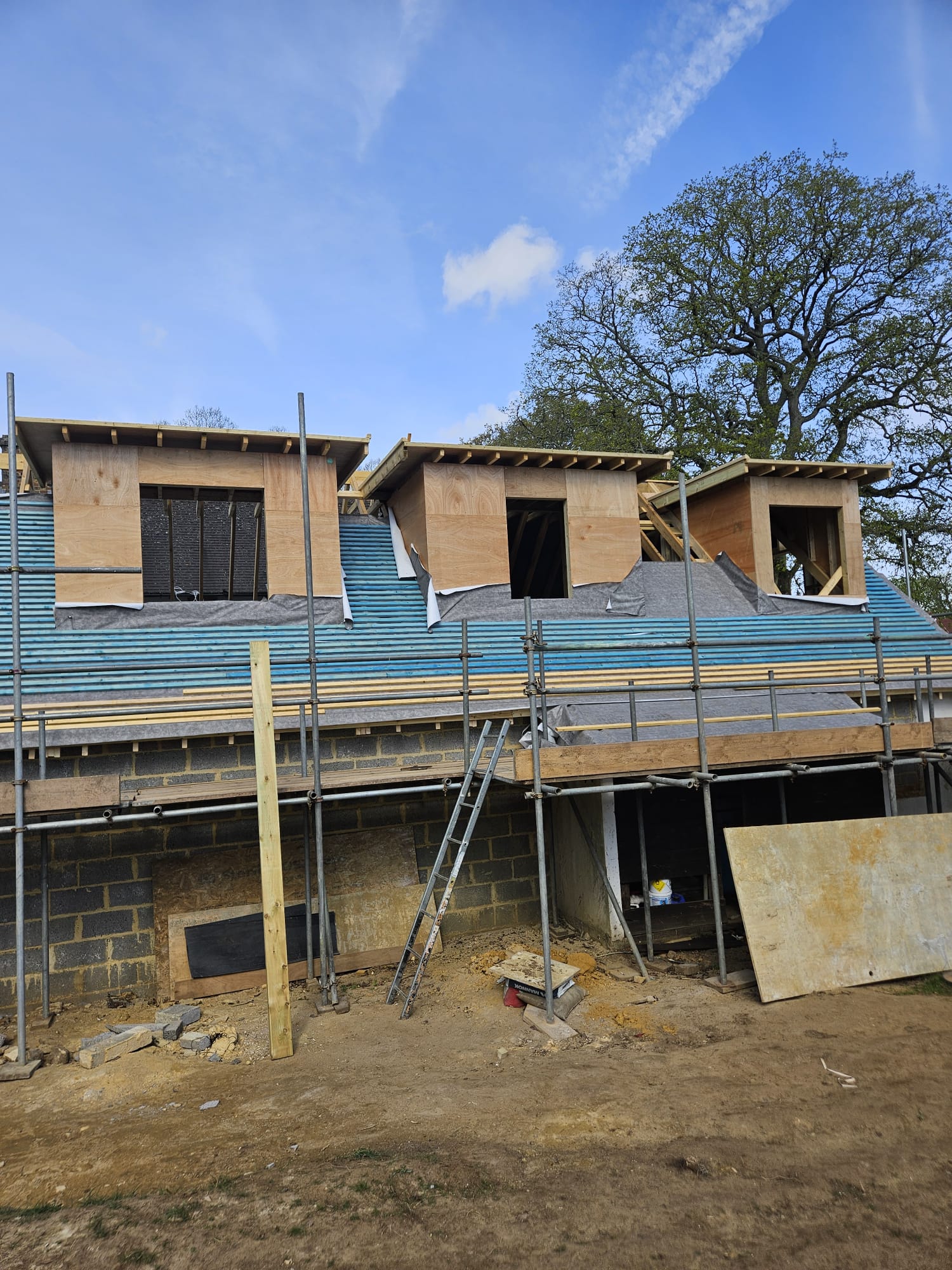
Tiled, slate and flat, plus the junctions between them: chimneys, valleys, abutments and dormers, where leaks actually start.
Honest advice on what next
If your roof is close to needing more than a repair, you are told plainly so you can plan rather than be surprised.
Workmanship guaranteed in writing
Repairs carry our workmanship guarantee, backed by £2m public liability and £10m employers' liability cover.
In detail
The repairs we carry out, and where leaks genuinely come from
Roof repairs sound like one service but cover a dozen distinct failures. These are the ones we deal with most often on Surrey houses.
Tiles, slates, battens and felt
Slipped, cracked or missing tiles and slates are the most common single fault, and they are usually a symptom: corroded nails, a broken batten, or felt that has perished and no longer supports the course.
We replace like with like wherever possible so the repair does not stand out as a bright patch on a weathered roof, and we make good the batten and felt beneath rather than simply refitting the tile.
Where a roof is losing tiles across large areas because fixings and felt have reached the end of their life, we will say so; that is a re-roof conversation, not a repair.
Flashings, valleys and abutments
Flashings and valleys carry concentrated water, so they fail more often than the open roof. Splits, lifted edges and failed mortar at abutments are frequent leak sources on Surrey semis and extensions.
The correct fix is replacing or re-dressing the leadwork so the water is carried out over the tile, not sealing the joint with mastic that will fail again in a season.
Valley repairs also involve the tiles either side, which need cutting and bedding correctly for the valley to work as designed.
Ridge, hip and verge
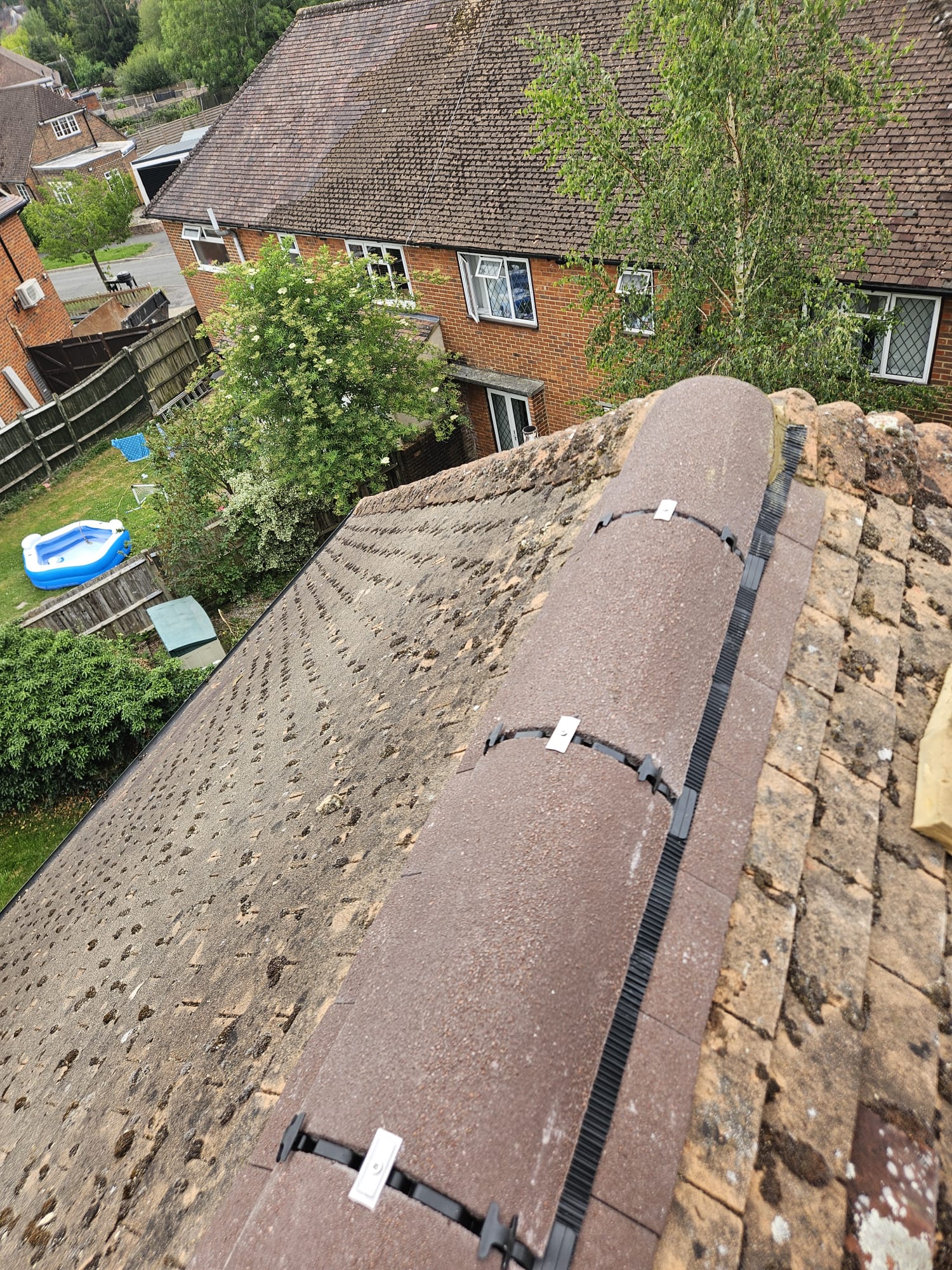
Loose or cracked ridge and hip tiles let water into the top of the roof and are a wind risk. Verges (the sloping edge at a gable) commonly crack and drop mortar, exposing the tile ends.
These are exposed, high-consequence details. Getting them secure quickly prevents wind lifting further courses in the next storm.
Chimneys, flat sections and storm damage
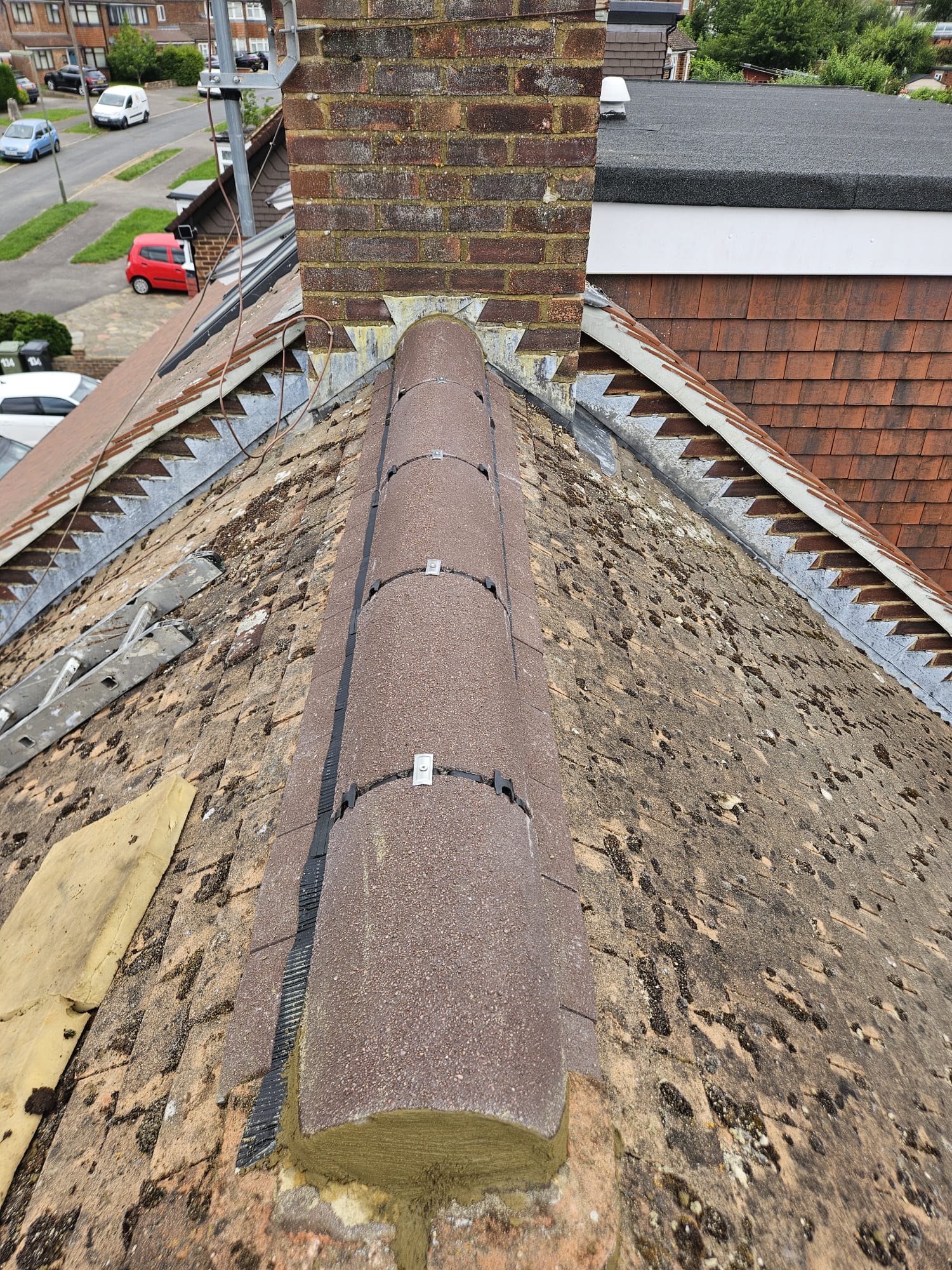
Chimney junctions combine brickwork, pointing, flaunching and lead in one small area, and a leak there can come from any of them. We deal with the whole detail rather than the easiest part of it.
Flat sections (porches, bays, dormers and extension roofs) leak at upstands, outlets and laps. We repair those where the deck is sound and tell you when it is not.
After storms we prioritise making the roof watertight and secure, then talk through the full repair once you can see what has happened.
Repairs on Surrey properties
Local housing stock ranges from period tiled and slate roofs to post-war semis and modern extensions, often with several roof types meeting on one building. Those junctions are where most of our repair work is.
Mature trees around Bookham, Fetcham and Ashtead mean moss and blocked gutters are a recurring contributor to leaks, so we look at those as part of a repair rather than as an upsell.
Being based in Bookham means you deal with the person who diagnosed the problem, and coming back to check something is straightforward.
Where we work
Covering Bookham
and the towns around it
We are based at The Manse, Eastwick Road, Bookham, Surrey and work across these Surrey towns and villages.
- General Roof Repairs in Bookham
- General Roof Repairs in Great Bookham
- General Roof Repairs in Leatherhead
- General Roof Repairs in Fetcham
- General Roof Repairs in Effingham
- General Roof Repairs in Ashtead
- General Roof Repairs in Epsom
- General Roof Repairs in Cobham
- General Roof Repairs in East Horsley
- General Roof Repairs in West Horsley
- General Roof Repairs in Shalford
- General Roof Repairs in Woking
- General Roof Repairs in Guildford
Not sure whether you are in range? Call 07877 013968 and we will tell you straight away.
Related work
Often done at the same time
See every roofing service we offer or go back to the homepage.
Questions
Straight answers
before you commit
Anything not covered here, ask Matt directly on 07877 013968.
How much does a roof repair cost in Surrey?
It depends on what has failed, how much of it there is and the access needed. A single slipped tile and a failed valley are very different jobs. Matt inspects the roof and gives a detailed written quote itemising the work, and what we quote is what you pay.
How quickly can you look at a leak?
Call rather than use the form for anything actively coming in. Our hours are Monday to Saturday 8am to 6:30pm and Sunday 9am to 4pm, and we will tell you honestly where you sit in the diary rather than promising a time we cannot keep.
How long does a repair take?
Many domestic repairs are completed in a single visit. Larger work (a full valley, several courses of tiles, or a chimney detail) can take longer, and you will be told the expected timescale before it is booked.
Is the repair guaranteed?
Yes. Repairs carry our workmanship guarantee in writing. Where the work falls into a specific category, the longer guarantees apply: 25 years on tiled roofs, 15 years on flat roofs, 10 years on guttering and fascia work, and 10 years on chimney and leadwork.
Why has my leak come back after being repaired before?
Almost always because the repair was aimed at where the water appeared rather than where it entered. Water can travel a long way along a batten or rafter before it drips, so a patch under the stain leaves the real entry point untouched.
Do you repair flat roofs as well as tiled ones?
Yes: tiled, slate and flat, plus the junctions between them. Flat roofing is one of our strongest areas, so a flat section on an otherwise tiled house is straightforward for us.
Will you tell me if my roof needs replacing rather than repairing?
Yes, plainly. If a repair only postpones the same cost, you will hear that. Anything we would recommend against gets said out loud rather than quietly quoted for.
Do you need access inside the house?
Sometimes briefly, to see where water is appearing or to look into the loft. That view often identifies the entry point far faster than working from the outside alone.
Do you cover my part of Surrey?
We are based in Bookham and cover Great and Little Bookham, Leatherhead, Fetcham, Effingham, Ashtead, Epsom, Cobham, East and West Horsley, Shalford, Woking and Guildford.
Are you insured?
Yes: £2m public liability and £10m employers' liability cover.
Next step
Find out what isactually leaking
Send the form and Matt will arrange to look at the roof, show you where water is getting in, and put a detailed repair quote in writing. If it is coming through now, calling is quicker.
Call 07877 013968The Manse, Eastwick Road, Bookham, Surrey, KT23 3BE
Mon–Sat 8am–6:30pm · Sun 9am–4pm